
Health professionals supporting people impacted by domestic abuse
Healthcare and mental health professionals are uniquely placed to identify abuse, open a conversation, and connect people with the right support.
This page sets out why domestic abuse is a healthcare issue, what you can do, and how Equation can support you and your team.
Quick guidance for health professionals
Domestic abuse has a profound and lasting impact on physical and mental health. People experiencing abuse are significantly more likely to present with anxiety, depression, self-harm, substance use and alcohol dependency, chronic pain, reproductive health complications and frequent attendance at GP surgeries and A&E.
Asking the question: Routine enquiry
NICE guidance recommends that practitioners ask about domestic abuse as a matter of routine.
Responding safely
• Seeing the person alone
• Believing them
• Documenting disclosure clearly
• Knowing your referral pathways
Confidentiality and information sharing

Asking the question
Professional curiosity is about exploring and understanding what is happening with a family, a child or an adult. It’s about not accepting a situation as it appears, especially if it doesn’t feel right.
This video explains why it’s so important in preventing death due to domestic abuse.
Why organisations choose Equation training
Health support resources
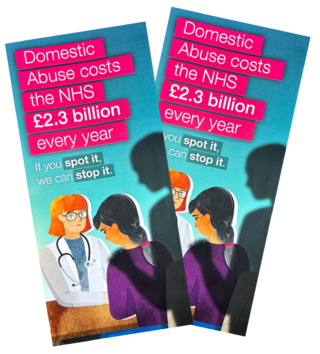
Leaflet for healthcare venues – supplied singularly
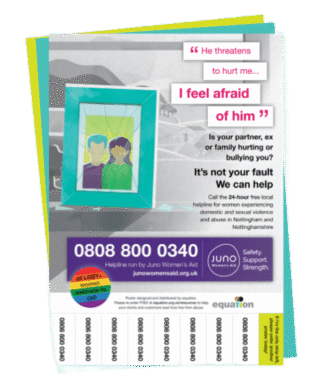
Rural abuse ‘He threatens to hurt me…’ – supplied singularly
Domestic abuse card – Advice and Support for Women – supplied singularly

Professionals newsletter
Sign up and receive our regular emails with the latest training, practical tools and research to help you support survivors and children affected by domestic abuse. You can also sign up to hear all the news from Equation, including information about our work and fundraising initiatives.
Training feedback from a healthcare setting:
“Informative, a real eye-opener to the way a perpetrator sees the home and dangers within. A good training session; I would recommend to other healthcare settings.”
Sarah
Family Support Worker

Training and workshops for healthcare settings
• Domestic abuse awareness: understanding what abuse is and how to respond
• Routine and safe enquiry: how to ask about domestic abuse as part of practice
• Sexual violence awareness: supporting patients who have experienced sexual violence
• Bystander intervention: supporting colleagues and patients

Understanding & Responding to Domestic Violence & Abuse – F2F – County
26/01/27
£0-£35

Working with Men Experiencing Domestic Abuse (County) – Online
11/03/27
£0-£35

Working with Children Impacted by Domestic Abuse – Remote – City
11/03/27
£0-£35

Technology & Economic Abuse: “One of the Greatest Forms of Control” -County
03/03/27
£0-£35

Recognising Perpetrators of Domestic Abuse: Understanding & Theory (Online)
03/11/26
£0-£35
Frequently asked questions
Here are answers to questions we hear often from healthcare and mental health professionals. If you can’t find what you’re looking for, get in touch.
What if a patient doesn’t want me to do anything about their disclosure?
This is one of the most common concerns. The most important thing is to listen, believe, and let them know support is available when they are ready. You should not pressure anyone to take action they are not ready for — this can increase risk. Document the disclosure clearly. If there is no immediate risk of serious harm, respect their decision while keeping the door open. If children are involved, or if the risk level is very high, you may have a duty to act even without consent — speak to your safeguarding lead.
I’m a mental health practitioner, not a domestic abuse specialist. Is it my place to ask?
Yes. Domestic abuse is one of the most significant contributing factors to poor mental health. You do not need to be a specialist to ask — you need to know how to ask safely, how to respond if someone discloses, and where to refer. Equation’s training is designed to build exactly that confidence. You don’t need to have all the answers — you just need to open the door.
What if I’m concerned about a patient but they haven’t disclosed anything?
Trust your instincts. If something doesn’t feel right — repeated presentations, injuries that don’t match the explanation, a partner who speaks for the patient or refuses to leave the room — document your concerns clearly. You can seek advice from your safeguarding lead or contact Equation without identifying the patient, to talk through your concerns and next steps.
How do I make an enquiry?
Visit out Make a referral page and use the form to send us a message.
What if the perpetrator is also my patient?
This is a complex situation that requires careful management. Do not share information about one patient with another, including confirming that someone is your patient. Seek advice from your safeguarding lead and, where appropriate, from Equation or your local MARAC coordinator. The priority is always the safety of the person experiencing abuse.
How do I ask about domestic abuse without causing offence or distress?
Research consistently shows that patients do not find being asked about domestic abuse offensive — many feel relieved that someone has raised it. The key is to ask in a way that is calm, private, and non-judgemental.
Is training available for our whole team, including admin and reception staff?
Yes — and we’d encourage it. Reception and admin staff are often the first point of contact for patients, and they can play a vital role in creating a safe environment. Equation’s training can be tailored to different roles and delivered across a whole team or organisation.